Tesla Robotaxi vs. Waymo: An Honest Head-to-Head Comparison in 2026


Real-World Performance: What the Data Shows
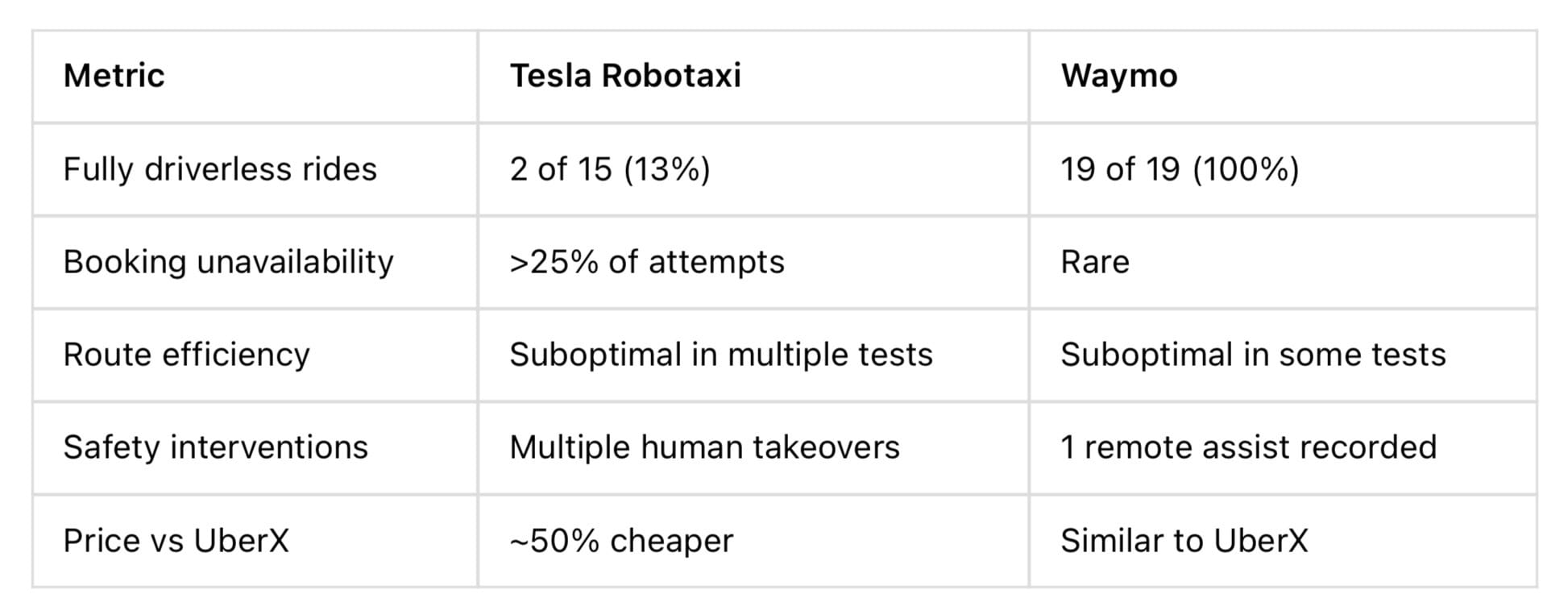
Investment bank Jefferies published a detailed analysis in early 2026 after analysts took over 15 rides with Tesla and 19 with Waymo across the same routes in Austin.
Their findings were revealing:
Tesla’s lower price is real — in Dallas, one analyst recorded a 2.25-mile trip at $6.15 on Tesla versus $13.93 on Waymo for the same route. Tesla’s current pricing formula is $3.00 base + $1.40 per mile with no tipping. But the catch is availability: Tesla’s fleet remains small, rides with no safety driver are still the exception rather than the rule, and the service has reported 14 crash incidents since launch.
Waymo, meanwhile, operates roughly 2,500 fully driverless vehicles across its network. Its safety record per mile driven remains significantly better than the US average for human drivers, though it is not without incidents.
The Passenger Experience: Riders consistently describe Waymo as the smoother, more polished experience. The vehicles are quiet, communicate clearly via in-car screens, and handle complex urban environments with what users describe as “calm confidence.” The app is reliable, ETAs are accurate, and the lack of a safety driver has stopped feeling novel — it just feels normal.
Tesla’s experience is more uneven. When it works — and it often does — the ride is genuinely impressive. The car feels alive in a way that older robotaxi systems don’t, responding fluidly to cut-ins and lane changes. But the uncertainty about whether a safety driver will be present, combined with occasional route oddities, undercuts the “fully autonomous” promise for now.
Both services receive consistent feedback that the vehicles drive cautiously — sometimes frustratingly so. Neither will gun it through a yellow light or take the aggressive merge that a human driver might choose.
Business Model: Who’s Making Money?
Neither company is profitable on a per-ride basis today — the economics of robotaxis depend on fleet scale that neither has yet achieved. Waymo’s path to profitability runs through volume: more cities, larger fleets, and a partnership strategy with Uber (in some cities, Waymo vehicles are bookable through the Uber app). Wolfe Research has estimated that at sufficient scale, the economics become compelling.
Tesla’s pitch is different: it claims it can manufacture Cybercabs at $30,000 per unit, far below what purpose-built robotaxis from Waymo, Zoox, or Cruise cost. If Tesla can achieve that cost target and deploy at scale, its margin structure could be transformative. The question is whether the technology will mature fast enough to make that possible.
The Verdict
Choose Waymo if: You want a reliable, fully driverless ride today. Waymo is the clear leader in operational maturity, safety documentation, and geographic coverage. If you’re in one of its cities, it works consistently and the experience is polished.
Watch Tesla if: You’re interested in where the technology is going. Tesla’s end-to-endapproach is architecturally bold, its cost structure could eventually undercut every competitor, and the pace of FSD improvement has been significant. But as a service today, it’s still catching up.
The honest answer for 2026: Waymo is winning the race for now. Tesla is building for a different race entirely.